
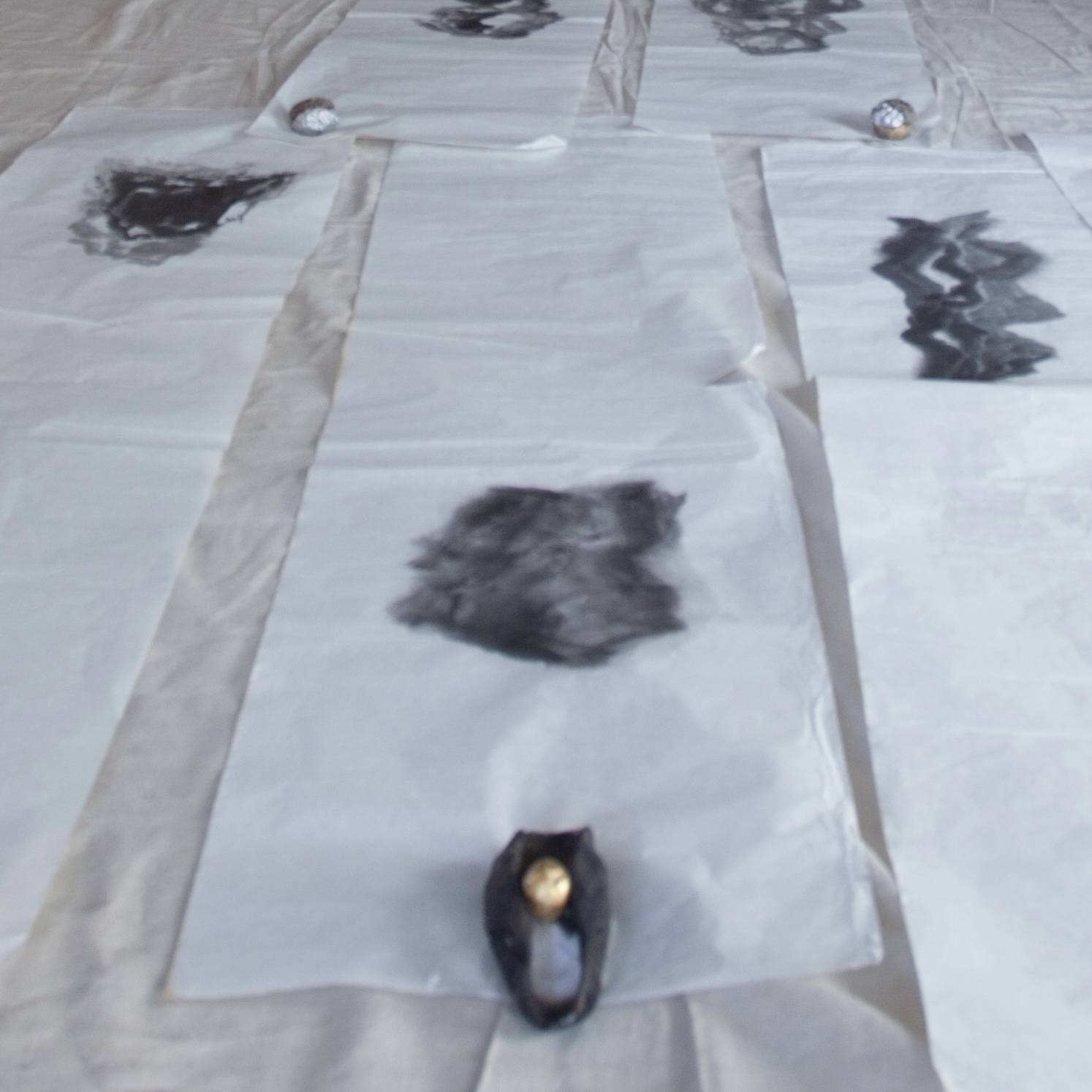
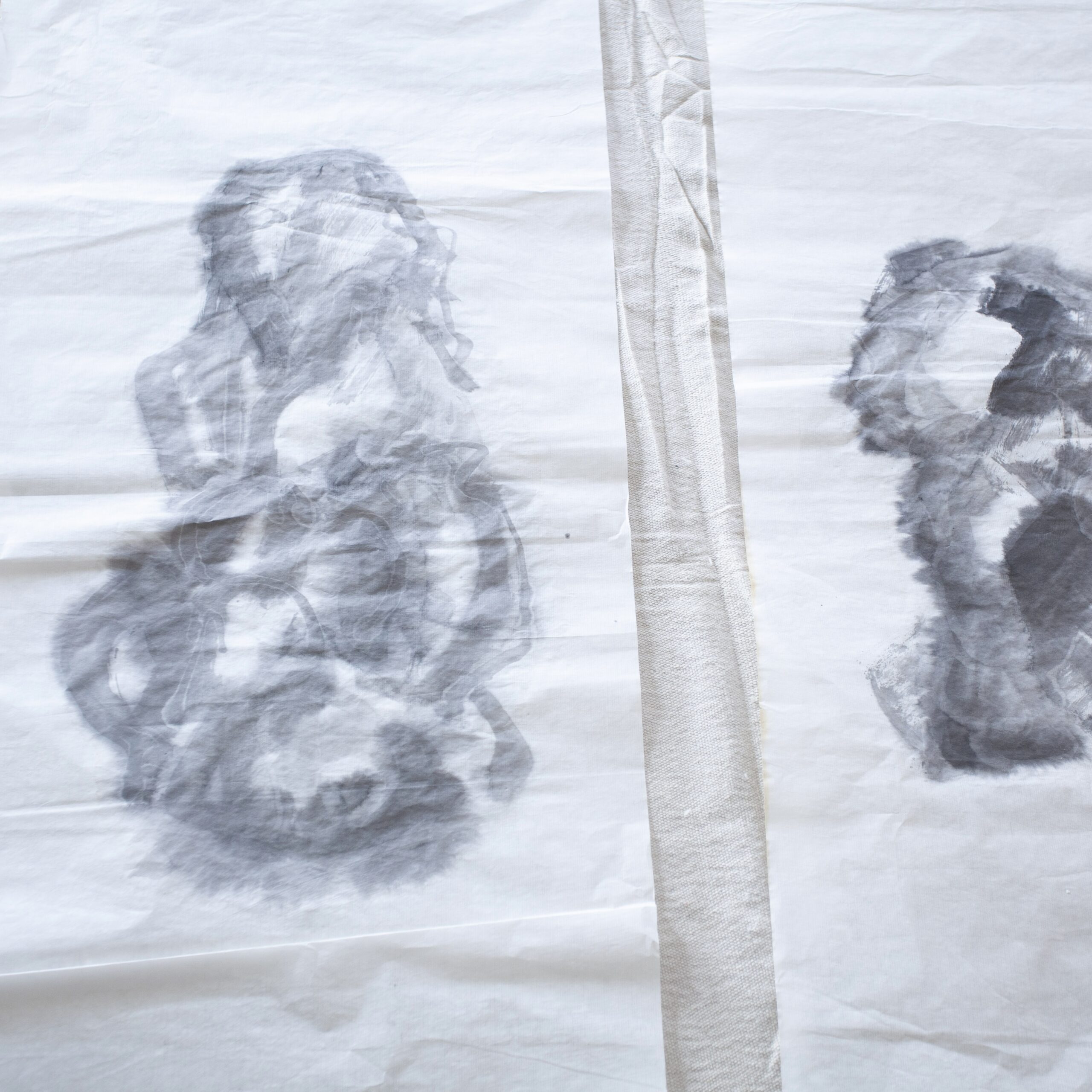
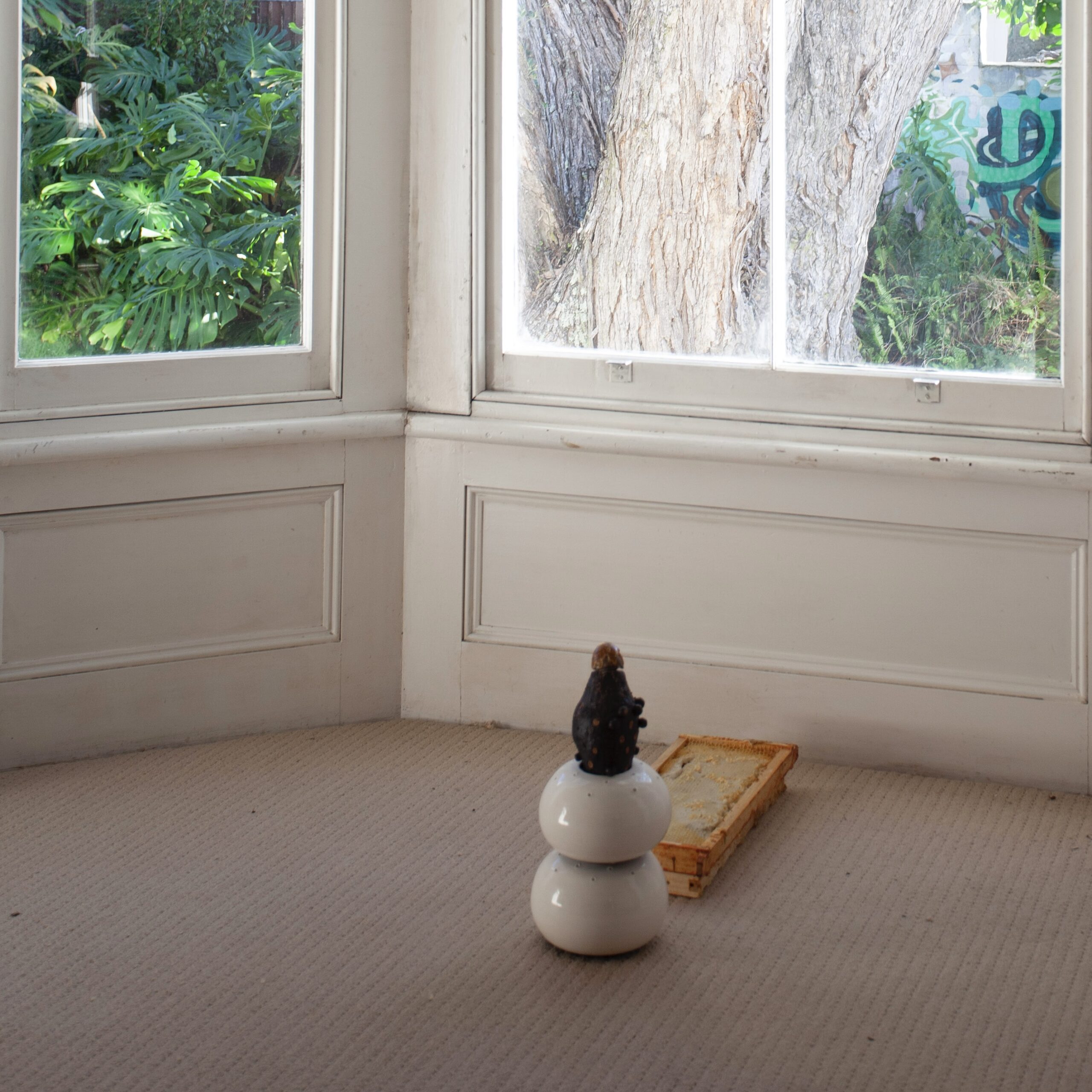
Brush on rice paper
Moments become thoughts and thoughts become the memories of the past.
Let them go.
The moment is the moment.
Brush on rice paper.
Empty mind.
The future arrives on the page.
On an afternoon in mid-autumn, Ryan Sun’s artworks from hisseries Xuanpin (Black seeds) are laid out on the floor and shelves of rooms in a shared dwelling in Herne Bay, Auckland. Late sun filters through the tall windows. The house is a century-old bungalow that was divided into three flats after World War II. A corridor leads from the main door down to this flat at the back of the house. Lining the path of the corridor is a grey carpet splashed with dark red flowers and green foliage. I have a sense of deja vu. Is it the carpet from my childhood home? The wallpaper in the rooms also acts to transport me back to my bedroom as a child. I spent hours trying to get to sleep on summer evenings, tracing patterns in the embossed wallpaper. Now most modern homes have painted walls. Underneath the paint some houses still have layers of paper, new paper applied on top of the old, the house holding all its memories in its skin.
I bring my camera to my eye to record images of the artworks. Itreturns me to the present. When I am taking photographs I am in the moment, paying close attention to what is before me. The past retreats.
Ryan, too, knows this. When he is making an artwork, or perhaps finding an object which he might place or mould with another material, he encounters the emptiness of flotsam, the openness of objects that have become unmoored. He says “Maybe you will find your own eye. A hole to see what is happening outside yourself.”
Ryan’s small works combining clay and metal and seeds are ambiguous objects, at times seeming to span a continuum from abstract forms to figurative subjects. I ask him if he would describe the works as sculptures. He responds: “I don’t know…they are about my hands, the clay in my hands.” For Ryan the boundary between himself and the natural world is not discrete.He likens this connection to a return to the mother’s womb, a space of intimate connection. The monochrome works on rice paper also have indistinct thresholds. Shadow and light bleed into each other like pools or valleys. Amorphous iterations, though in some of them I see the shape of a person or an island.
Sitting on the floor of the living area at a low table we talk about what it is like to live as an artist. We are in a creative, warm space. The materials of art-making are visible in the room, it is not chaotic, nor is it excessively tidy. There is a rhythm in this place which feels balanced. Ryan reflects on ideas of freedom and purpose.
“The centre of life is not about control or money. It is about yourself. Of course we have pressures, we all need to make a living. However, we also need some space and to connect to nature.”
I am curious about how to live in the world more freely. Freedom, creativity and spontaneity are concepts that I have been exploring through photography and writing for some time. On the wall adjacent to the low table is a sequence of four polaroid images. They are black and white images of Ryan’s ceramic objects, all photographed on a windowsill in this house. They are strange, other-worldly images, somehow reminding me of the daguerrotype The Artist’s Studio/Still Life with Plaster Casts, 1837, by Louis-Jacques-Mandé Daguerre. When I am looking through the lens I am in the moment but when I am looking at photographs I am always time-travelling. For me, photographs always evoke other places, other times, other photographs. They are like layers of wallpaper, each with its own patina.
Ryan has used polaroid film that expired in 2008 to create his photographs. He describes how with his first attempts, the film was stuck to its paper envelope. The image was unable to be revealed. This collection of wounded images lies on the table, the patches of film on the dark paper in patterned formations like abstract paintings. Eventually Ryan discovered that the solution was to remove the film in a dark bag. He laughs and says he was helping the photographs to be born.
“We are always living with a boundary,” observes Ryan. “Born the son of parents, that’s a boundary. Starting school, another boundary. How do we create ourselves?”
Maybe the artist’s task is not necessarily to answer this question, but to keep asking it, in different ways.
We walk out into the garden where there is a large feijoa tree. Ryan circles the tree, looking for fruit but it is too late in the year. The tree has given up all its fruit for this season. I feel my feet on the ground, the sun is low in the sky. I do not photograph themoment but it will be stored in my memory: Ryan behind the tree, the windows of the house reflecting the last of the afternoon light. A poem by Sarah Broom recalls my feeling in this moment of time in the garden:
I was once very small
I was once very small
I was once very small
______________
Yvonne Shaw